
Motorized Goniometers 960-0180
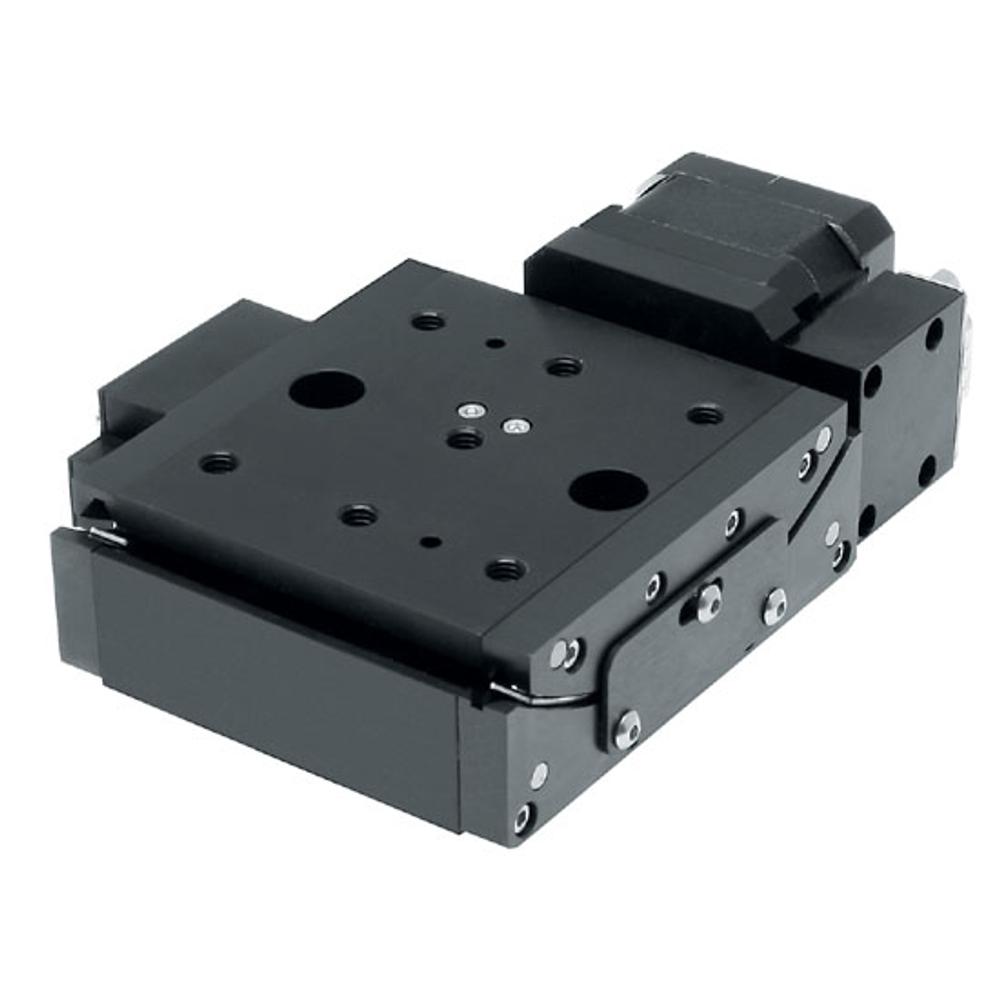
• Rotates an object without obscuring the optical path • Superb stability • 1 or 2 axes of rotation (stackable) • Smooth operation with ball bearings • Compact square body Motorized goniometers rotate an object about… Read more →
Listed in
Order
| SKU | Spec | |
|---|---|---|
| 960-0180-50 |
Out of stock
$1,198
|
|
| 960-0180-80 |
Out of stock
$1,198
|
|
| 960-0189-50 |
Out of stock
$1,198
|
|
| 960-0189-80 |
Out of stock
$1,198
|
Specifications
| 960-0189 | 960-0180 | |
|---|---|---|
| Travel range | ±2.5° | 0.5° |
| Resolution / 960-0189 / 0180-50 / 960-0189 / 0180-80 | 16.12" / 10.96" | 20.6" / 16.5" |
| Lifetime | - | 20 million / full steps |
| Height of center of rotation / 960-0189 / 0180-50 / 960-0189 / 0180-80 | 50 mm / 80 mm | 50 mm / 80 mm |
| Load capacity | 2 kg | 2 kg |
| Motor connector | DB9(M) | DB9(M) |
| Mottor | 4233 | 4233 |
| Optocoupler end limit switches | 2 | 2 |
| Switch polarity | pushed is open | pushed is open |
| Motorized Goniometers - DWG file | |
| Motorized Goniometers - STEP file |
Description
- Rotates an object without obscuring the optical path
- Superb stability
- 1 or 2 axes of rotation (stackable)
- Smooth operation with ball bearings
- Compact square body
Motorized goniometers rotate an object about an axis in a space located outside the body of the unit (usually above the platform), so the axis is not obscured by the unit itself.
Goniometers have small travel range and greater stability, compared to rotation stages.
Goniometers have to have different heights of points of rotation, so that, when you stack goniometers one on top of the other, they rotate an object about a common point in space. The mechanism rolls smoothly on ball bearings.
The position is read within one revolution on the scale engraved on the dial knob sitting on the axle of the motor. Position can be read to each step. Overall position accounting is up-to your computer.
Goniometers have two limit switches to signal an "out of limits" error situation. The switches may also be used to roughly establish a zero reference. Precise position may be established visually. The stage is driven by a stepping motor. A dial knob on its axle allows manual drive.
Encoders or Revolution sensors are available on request. More information.